Paper vs cloud
Emergency binder vs digital vault: which should your family trust?
Paper binder or a cloud vault like Trustworthy or Everplans? We compare security, ten-year cost, and what actually works on the worst day.
8 min read··By the InCaseBinder team
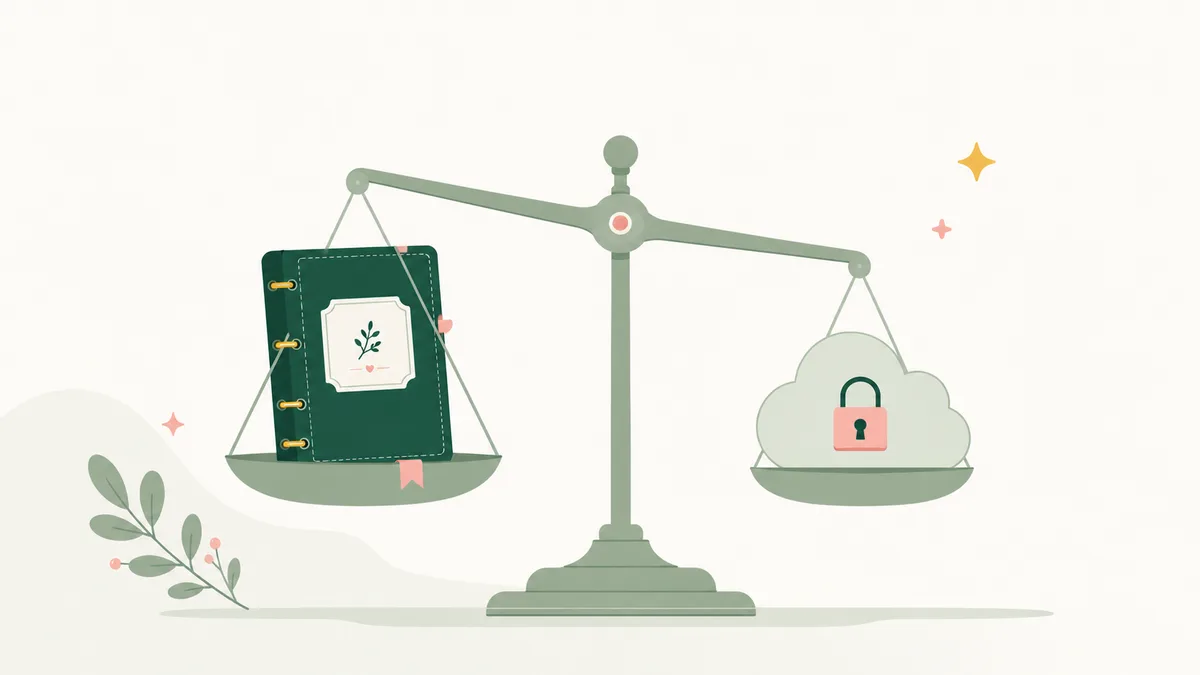
A paper emergency binder and a cloud digital vault solve the same problem with opposite trade-offs: the binder is unhackable, subscription-free and works in a blackout, while the vault survives house fires and updates itself from your phone. The right choice depends on which failure scares you more — and on whether you want to pay once or forever.
We're biased and we'll say it plainly: we make InCaseBinder, a binder builder. So below we're deliberately steel-manning the vaults — they have real advantages, and for some families they're the better fit.
The head-to-head comparison
| Paper binder | Digital vault | |
|---|---|---|
| Cost over 10 years | $0–60 (one-time) | ~$1,000–4,800 (subscription) |
| Remote breach risk | None — it's paper | Real: your most sensitive data on a company's servers |
| House fire / flood | Vulnerable (mitigate: fireproof safe + copies) | Survives — data is off-site |
| Works in a blackout / dead phone | Yes | No |
| Family needs credentials? | No — they need to know where it is | Yes — account, password, sometimes 2FA of the deceased |
| Company shuts down | Irrelevant | Export scramble or data loss |
| Updates | Reprint a page (or re-generate the PDF) | Edit from your phone — genuinely more convenient |
| Multi-person collaboration | Whoever holds the binder | Built-in sharing and roles — a vault strength |
Where digital vaults genuinely win
- Disaster resilience.If your region floods or burns, off-site data wins. (A binder copy at a relative's house closes most of this gap.)
- Continuous updates. Vaults nudge you and sync changes instantly. Paper goes stale unless you calendar a yearly review.
- Distributed families.Adult children in three states can all hold access to a parent's vault. Paper lives in one place.
Where the paper binder wins
- The worst day itself. Grief plus a password-reset flow is a brutal combination. A binder needs no login, no app, no battery, no surviving 2FA device.
- Privacy by physics.Nothing uploaded means nothing breachable at scale. Vault companies are honeypots by definition — one breach exposes thousands of families' everything.
- Cost certainty.No auto-renewals, no price hikes, no “your plan has changed” emails. Money matters compound: $200/year for 20 years is $4,000 for storage of information that fits in 20 printed pages.
- No company risk.Paper doesn't pivot, get acquired, or sunset.
Our verdict, by family type
- Most households: printed binder at home + encrypted backup file in your own storage. You get the blackout-proof paper AND the off-site copy — without the subscription. (This is the setup InCaseBinder produces by default.)
- Families coordinating care for parents across several states:a vault's sharing model may justify the fee — or start with our guide to organizing aging parents' documents and see how far one binder gets you.
- High-disaster-risk areas:whichever you choose, keep one copy off-site. Paper's only true weakness is geography.
And if you're comparing specific paper options, our honest comparison of emergency binder templates breaks down the printables, PDFs and builders by price and time-to-finish.
Frequently asked questions
Is a digital vault safer than a paper emergency binder?
They fail differently. A vault can be breached remotely, locked behind a forgotten password, or shut down if the company folds — but it survives a house fire. A paper binder can burn or be stolen from your home — but it can't be hacked, doesn't expire with a subscription, and works during an internet or power outage. The strongest setup is a paper binder plus an encrypted digital backup you control.
How much do digital vaults like Trustworthy and Everplans cost?
As of this writing, Trustworthy's paid plans run roughly $120 to $480 per year, Everplans is about $99 per year, and GoodTrust's estate package is around $149 for the first year with a renewal fee after. Over ten years that's roughly $1,000–4,800 — versus a one-time $0–60 for binder templates and builders.
What happens to a digital vault if the company shuts down?
You're depending on the company's wind-down process: export windows, data migration offers, or in the worst case, loss of access. It's a real consideration — end-of-life tech startups have folded before. Paper and local files have no such dependency.
Can I have both a binder and a vault?
Yes, and belt-and-suspenders families do. A common setup: a printed binder at home for the first 48 hours, and either a vault subscription or — cheaper — an encrypted backup file stored on a USB stick and in your own cloud drive for remote access and updates.
What works fastest in an actual emergency?
Paper. In the first hours after a death or accident, family members are stressed, may not know the vault exists, don't have the login, and may be dealing with a dead phone. A labeled binder on a shelf — with a one-page 'who to call' sheet up front — requires zero credentials and zero battery.